
 Country #47, Laos!
Some fun facts about Laos; It is the most heavily bombed country (per capita) in the history of the world. Laos was bombed non-stop by the USA from 1964 to 1973 at a cost of nearly seven billion dollars. Over two million tons of high explosive rained down from bomber raids launched on average once every eight minutes. The tonnage exceeds all the raids launched by every side in Europe during the whole of World War II. The lethal barrage, which peaked in 1969, included an estimated 250 million submunitions, notably infamous anti-personnel "bombies". Slightly smaller than tennis balls, and sometimes painted bright yellow, bombies can attract curious children and may be mistaken for fruit. 30% of these landed intact, and children die every week from them some 36 years leater.
Bearing all this in mind, it would be understandable to receive some anti-American sentiment. When the French or Dutch complain about American foreign policy I resist the temptation to ask them if their grandpa ran or bicycled away when the SS rolled into his town. But to people from countries like Laos, Cambodia, I can't defend my countries actions.
 The Nam Khan river
 Lao people are reserved, laid-back, calm, polite, patient, graceful. They seem surprised that so many Westerners want to visit their country.
On a Friday night, you'll see Lao teenage boys on their mopeds, with their girlfriends on the back, sitting sidesaddle, texting away on their cell phones. Mopeds outnumber cars 10-1, and bicycles outnumber mopeds. The total volume of motorized traffic is minimal.
Laos is wonderfully cheap. I had fantastic Indian food at Nazim's each night for $4. A big beer Lao is only $1.50 An hour massage $6. A full day's tour $11.
 Laos is one of the few remaining "Communist" countries. It's not really Communist, in that it has free trade and capitalism just like any other country, but it is still ruled by the same Lao People's Democratic Party" that has ruled it since the Vietnam war. There are no free elections, and no free press.
I exchanged dollars at the Lao Peoples Bank. Basically the equivalent of exchanging money directly with the government. In Myanmar the government offers an absurd exchange rate of 6 kyat to the dollar, less than 1% of the real exchange rate. What was the exchange rate offered by the Lao government? Exactly the daily rate published on the world currency exchange; 8,538 Kip for one dollar. I guess Laos wants dollars.
The first thing that greeted me upon checking into my room was a laminated copy of the Lao People's Democratic Republic Accommodation Regulations. Twelve rules were listed, and I'll share the most interesting/hilarious rules verbatim:
#1 Tourists have to your own accommodation at 2400 hrs (mid night)
#5 Do not any drugs, crambling, or bring both women and men which is not your own husband of wife into the room for making love.
#6 Do not allow domestic and international tourist bring prostitute and others into your accommodation to make sex movies in our room, it is restriction.
#11 If you do not follow this accommodation regulation, you will be fight based on Lao PDR law.
So, for those of you hoping to start up the Lao porn industry, or thinking of doing any "crambling", you best think again or you will be fight. (Fined?)
 That Pathum
 Wat Xieng Thong
 Monks whitewashing the stairway up Phou Si
 Laos makes everyone sleepy. The power was out to the whole town on Saturday from early in the morning till 3pm. Nothing to do but walk around town, have a Beer Lao, get a massage, and take a catnap.
 Main street. No cars, few people. Sleepy Laos.
 People really do wear these hats here.
 In Laos I stopped haggling at the markets. In Thailand they quote you a price that is 50-100% higher than what they will accept and it's expected you will attempt to haggle it down. On a $10-$20 item, it's certainly worth the time to haggle, pretend to walk away, the whole bit. In Laos they quote you a price that is a hopeful 25%-50% above what they will accept. This opening price will likely be less than the price you'd negotiate after five minutes of haggling in Thailand. Things are so, so cheap here. Can you talk a Lao merchant down from $3.50 to $2.75 for the Beer Lao t-shirt you've been eyeing? Probably. Will you feel that same sense of victory by keeping an extra 75 cents out of the hands of a woman who makes three dollars a day? Probably not.
I bought a beautiful handmade lantern from this lady. I took some time in deciding which one I wanted, and she interpreted my hesitancy to lack of interest and dropped the price from $8 to $6 without a word from me. If I'd had more room in my backpack, I'd have bought ten of them.
 The huge night market in Luang Prabang
 Quiet back streets of lovely Luang Prabang
 Like many places in Buddhist Asia, the monks walk the streets at dawn to collect alms from the laypeople. This tradition dates back a thousand years. There are so many monks in Luang Prabang, and the town is so picturesque, that this simple ceremony draws out every tourist in town. Some give alms like the locals. Most just snap pictures. Unfortunately, a few morons insist in getting right up in the monks faces for that perfect shot. There are signs around town asking for people to show some restraint and not interfere with this vital ritual. I took this shot from across the street. I witnessed a tour bus of Japanese with bright flash photography just a few feet from some monks. I was disgusted by the whole scene. Rich tourists with $800 cameras frantically snapping photos of penniless monks patiently receiving the only food they would get for the day is just wrong. I saw one sign on a shop window that put it best; "They are monks not monkeys. Do not treat them as if they are in a zoo. Please respect Lao traditions."
 It's hard to see it, but in the left side of this picture is a "working elephant" This elephant was on a tether and was moving logs for a man next to it. This is the first time I've ever seen an elephant not in a zoo. Laos has a few wild elephants, but they are dwindling fast and need better protection.

 The huge night market in Luang Prabang
 Quiet back streets of lovely Luang Prabang
 Like many places in Buddhist Asia, the monks walk the streets at dawn to collect alms from the laypeople. This tradition dates back a thousand years. There are so many monks in Luang Prabang, and the town is so picturesque, that this simple ceremony draws out every tourist in town. Some give alms like the locals. Most just snap pictures. Unfortunately, a few morons insist in getting right up in the monks faces for that perfect shot. There are signs around town asking for people to show some restraint and not interfere with this vital ritual. I took this shot from across the street. I witnessed a tour bus of Japanese with bright flash photography just a few feet from some monks. I was disgusted by the whole scene. Rich tourists with $800 cameras frantically snapping photos of penniless monks patiently receiving the only food they would get for the day is just wrong. I saw one sign on a shop window that put it best; "They are monks not monkeys. Do not treat them as if they are in a zoo. Please respect Lao traditions."
In the morning I went on a cool riverboat trip up the Mekong. For just $10 I got to ride in a thin long riverboat about 15 miles up the river to the Pak Ou caves, where a multitude of Buddha statues have been gathered for a long time. (One tour guide claims they are 4000 years old, which is a little bit off since Buddha was born only 2500 years ago.) At these caves were the usual vendors selling cold drinks and books. I'm passing by these kids selling bracelets, when suddenly I realize one of them has a giant rat on a string! I jumped back as the thing lunged toward me. The kids are trying to get me to do something with this ratlike creature, and I'm just trying to get away. I figured out that it was a mole, a big mole, and they wanted me to pay to set it free, just like with the sparrows in Chiang Mai. Note to Lao entrepreneurs; sparrows are cute, and Westerners want to free birds. Rodents are nasty, and we generally try to kill them.
 It's hard to see it, but in the left side of this picture is a "working elephant" This elephant was on a tether and was moving logs for a man next to it. This is the first time I've ever seen an elephant not in a zoo. Laos has a few wild elephants, but they are dwindling fast and need better protection.
In the afternoon I took a trip south to the Kuang Si waterfall. For $4 I got a ride in a tuk-tuk 20 miles out of town and entry to a beautiful forest reserve with a waterfall and several swimming holes.
Little did we know it, but the Tuk-Tuk ride there would be the most exciting part of the trip.
The Lao New Year was just a few days away. New Year comes at the hottest part of the dry season, and it is customary for kids to throw water on anyone they can during the three day festival. Well, on the road to Kuang Si, the kids started early.
Someone must have told them, "Look kids, there's going to be loads of foreigners in open tuk-tuks coming this way from Luang Prabang. They are on their way to the waterfall, so they are already dressed in swimming attire. It's open season."
We never expected the first salvo. Five kids with buckets of water waiting behind a slow curve drenched the back part of the Tuk Tuk. Our truck was full with four Brits, two Swiss, and me.
The Swiss took the brunt of this one. We were shocked, and laughing. The next group of kids we were ready for. Everyone dove to the floor and avoided most of the deluge. The third group was the piece de resistance. These kids had a half dozen threatening with buckets on the left side of the road. We all dove to the right side of the tuk-tuk and faced away. Big mistake. Hiding behind a berm on the right side of the road were another half dozen kids with buckets.
I was blasted in the face by a couple gallons of water. Everyone was soaked. They got us, and they got us good.
This guy, Saeng, was on assignment to the waterfall to practice his English with any English speaking foreigner that would take the time to talk to him. His English needs a lot of work, but he told me that the next time I come to Luang Prabang he'll have opened a new restaurant.
 The blurry figure in the center is me, a split second after letting go of the rope swing.
 On the way back from the waterfalls we stopped at a small Hmong village. This was certainly the poorest village I have ever seen. Handmade wooden huts, no electricity, no running water, sickly looking children. The sales pitch from the kids selling stuff had a bit of desperation here. Each girl was singing the same song, while displaying her hands toward the merchandise like some Laotian macarena. As you walked away from her table, the pitch and speed of the song would intensify. Finally I understood that the song they were all singing was in English and the only line was "You can buy some thing from me." I wanted to get out of this place cause these kids were breaking my heart. I bought ten bracelets from this girl, total cost $2. Her mom was pleased, but she doesn't look too happy.
 The blurry figure in the center is me, a split second after letting go of the rope swing.
I hadn't jumped off a good rope swing in 15 years. I probably shouldn't have pumped 10 times though, cause my arms were pretty sore the next day.
 On the way back from the waterfalls we stopped at a small Hmong village. This was certainly the poorest village I have ever seen. Handmade wooden huts, no electricity, no running water, sickly looking children. The sales pitch from the kids selling stuff had a bit of desperation here. Each girl was singing the same song, while displaying her hands toward the merchandise like some Laotian macarena. As you walked away from her table, the pitch and speed of the song would intensify. Finally I understood that the song they were all singing was in English and the only line was "You can buy some thing from me." I wanted to get out of this place cause these kids were breaking my heart. I bought ten bracelets from this girl, total cost $2. Her mom was pleased, but she doesn't look too happy.
 Laos really does have a midnight curfew. Not that there's anything much to do after midnight anyway. Luang Prabang has only two real bars; Hive and Lao Lao Garden. I spent a couple nights hanging at Lao Lao Garden and got to know the owner, a young Lao enterpreneur named Sompon. He manages the business and has a German investor, they split the profits 50-50. Lao Lao Garden has to close at 11:30 so that everyone has time to get home before the curfew.
Sompon tells me that no one actually gets arrested for being out past curfew, least of all a foreigner. He also says there are two businesses that the government allows to stay open late, the Dao Fah disco and the bowling alley. He offered to take me to both. After closing down the Garden we rounded up a couple tuk-tuks and got every foreigner who wanted to keep partying to climb in. One Aussie guy wanted to haggle the tuk-tuk price with the driver, while I tried to explain to him that the cost of the trip amounted to 50 cents per passenger, so what the hell was he arguing about? We all rode whooping and yelling to Dao Fah, and then listened to a mix of crappy Thai pop music and Akon. You have one drink choice at Dao Fah; large bottles of Beer Lao. You stand in one line to pay, get a ticket, then stand in another line to turn your ticket in for your beer. After damaging our eardrums for a bit, the crew piled back in the tuk-tuks for the bowling alley. Bowling? In Laos? at 1am? Sure, why not. I bowled atrociously, perhaps worse than Barack Obama. At some point I got back in the tuk-tuk for the final ride of the evening and was safely deposited at the door of my guesthouse. A day in Luang Prabang reminds me of a day at summer camp. You see all the same people everywhere, and you all move from activity to activity at roughly the same time. I love it.


 Songthaew ride down from Wat Phra That Doi Suthep. This wat is on top of a 3000ft hill a few miles outside town. The twisty switchback ride up got Lindso carsick. She just barely held on till we stopped at the top and then hurled out the back of the truck.


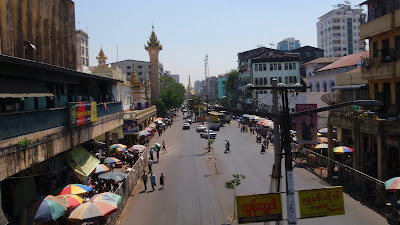

 view of Sule Pagoda from the MayShan rooftop
 Finally I reached the New Delhi restaurant. I was invited to pick any table by one of my six personal waiters. I was the New Delhi's only customer. My curry was decent, and I was brought generous helpings of extra rice. Midway through the meal the power went out to the city.


